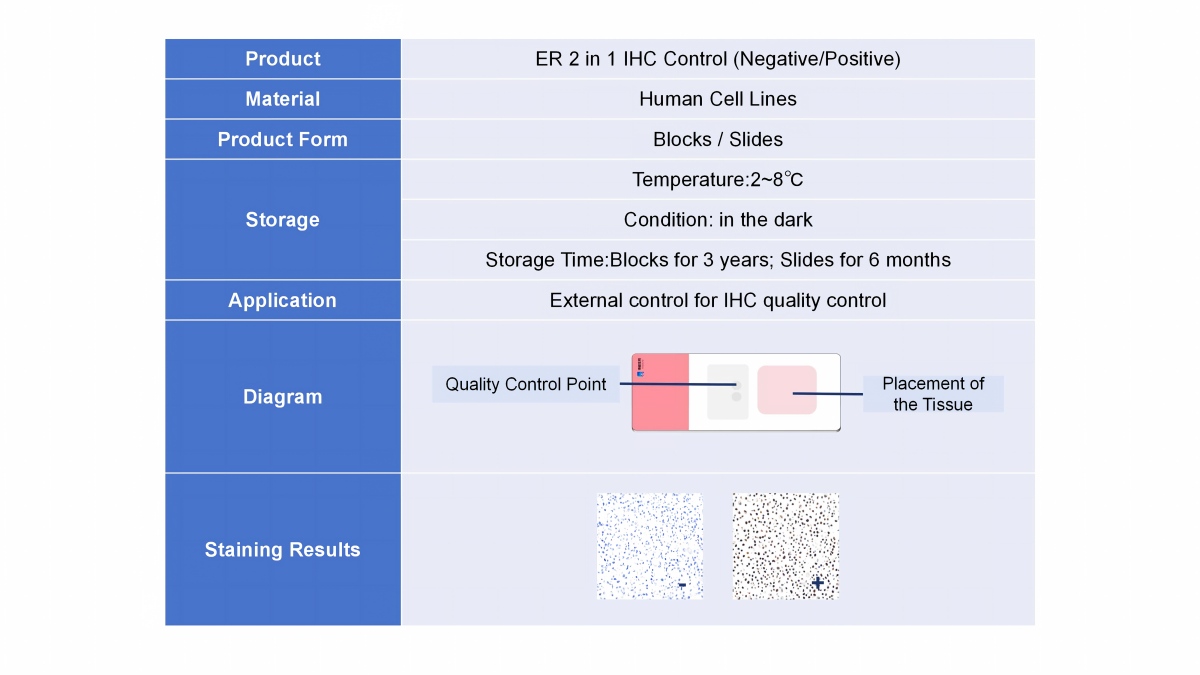
Why Should ER Be Tested in Breast Cancer?
Estrogen receptor (ER) is an important biomarker in breast oncology,it is used to build prognostic models; to stratify patients into different treatment streams (e.g., hormone receptor-positive cancer versus triple-negative breast cancer); to predict the likelihood of pathological complete response (pCR) to neoadjuvant chemotherapy (NACT); and to select patients for genetic testing.Estrogen receptor expression indicates a biological dependency on estrogen signaling, and notably, therapeutic effects correlate with ER levels in tumor cells. ER status is essential for clinical decision-making and outcome prediction in patients with breast cancer (BC): ER-targeted therapies have significantly improved clinical outcomes in patients with ER-positive BC.
The Importance of Quality Control in Breast Cancer ER IHC Testing
ER exhibits nuclear staining. However, a range of factors—including fixation, antigen retrieval, antibody clones, reaction time, temperature, and substrate concentration—can influence ER staining intensity. It is essential to implement quality control measures to ensure the accuracy of ER IHC results.Quality assurance for ER IHC should extend beyond participation in national external quality assurance schemes and other initiatives such as yearly or periodic monitoring of the positivity rate per institution. It should also include the use of external and internal positive and negative controls; collective and pathologist-level monitoring of overall positive and negative rates; and further investigation of borderline cases—such as ER low-positive results, ER−/PR+ cases, and tumors with unusual staining patterns (potential false-positive cases including strong background staining and granular nuclear staining with cytoplasmic spillover)—to identify any drift in assay sensitivity.
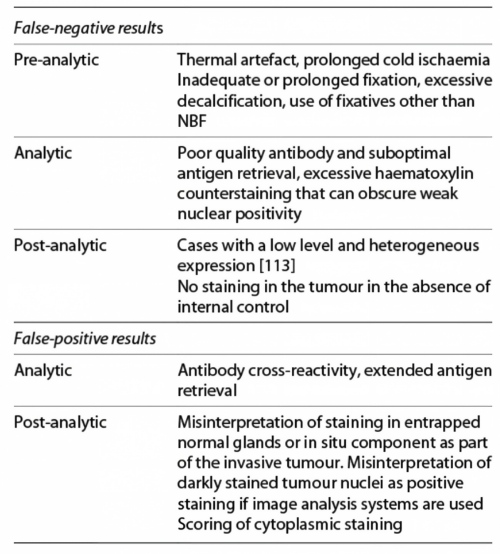
Table 1. Causes of false ER test results
References
[1]. Reinert T, Cascelli F, de Resende CAA, et al. Clinical implication of low estrogen receptor (ER-low) expression in breast cancer[J]. Front Endocrinol (Lausanne). 2022 Nov 24;13:1015388.
[2]. Rakha EA, Chmielik E, Schmitt FC, et al. Assessment of Predictive Biomarkers in Breast Cancer: Challenges and Updates[J]. Pathobiology. 2022;89(5):263-277.
[3]. Gown AM. Current issues in ER and HER2 testing by IHC in breast cancer[J]. Mod Pathol. 2008 May;21 Suppl 2:S8-S15.
[4]. Allison KH, Hammond MEH, Dowsett M, et al. Estrogen and Progesterone Receptor Testing in Breast Cancer: ASCO/CAP Guideline Update[J]. J Clin Oncol. 2020 Apr 20;38(12):1346-1366.